There are approximately 165,000 healthcare-associated infections (HAI) occurring in Australian acute care facilities each year, with more than half considered preventable (NHMRC 2026).
What is Aseptic Technique?
Aseptic technique is a set of practices used to minimise the transmission of microorganisms during clinical procedures, thereby protecting patients from healthcare-associated infections and protecting healthcare workers from contact with blood, body fluids and body tissues (SA Health 2026).
Poorly performed aseptic technique has been identified as a significant contributor to preventable HAIs (WACHS 2023).
Failure to maintain asepsis during clinical procedures can lead to healthcare-associated infections, delayed recovery, longer hospital stays, increased healthcare costs, and significant patient harm. For this reason, aseptic technique is a vital patient safety practice.
It is important to recognise that asepsis differs from sterility. Sterility refers to the complete absence of all microorganisms and is generally achievable only in highly controlled environments such as operating theatres. Aseptic technique aims to minimise contamination to a level that prevents infection. (ACSQHC 2021).
Aseptic Technique in the National Safety and Quality Health Service Standards
The National Safety and Quality Health Service (NSQHS) Standards recognise aseptic technique as a critical strategy for reducing healthcare-associated infections and improving patient safety (ACSQHC 2023).
As per Action 3.11, all healthcare organisations are required to:
- Identify the procedures requiring aseptic technique
- Assess staff competency in performing aseptic technique
- Ensure training is provided to address any competency gaps
- Monitor staff compliance with the relevant organisation’s policies on aseptic technique.
(ACSQHC 2023)
This action aims to minimise the risk of infection transmission during clinical procedures by ensuring that all health service organisations implement a risk-based aseptic technique process (ACSQHC 2023).
Aseptic Technique Under the Strengthened Aged Care Quality Standards
Standard 5: Clinical Care - Outcome 5.2: Preventing and controlling infections in clinical care under the Strengthened Aged Care Quality Standards (Action 5.2.2) advises registered aged care providers to establish processes to prevent, minimise and manage infection risks associated with clinical care (DoHDA 2025).
This includes ensuring that appropriate infection prevention and control practices, such as aseptic techniques, are applied when providing clinical care to older people (DoHDA 2025).
When is Aseptic Technique Used?
Aseptic technique is required whenever a procedure involves contact with a susceptible body site, breach of skin integrity or insertion and management of invasive medical devices. It helps prevent contamination from healthcare worker contact, equipment or environmental sources (ACSQHC 2021; WACHS 2023).
Common examples include:
- Intravenous fluid or medicine preparation and administration
- Simple and complex wound dressing
- Urinary catheter insertion
- Intravenous cannula or central venous catheter insertion and maintenance
- Drainage bag emptying or changing
- Surgical and other invasive procedures
- Tracheostomy care and suctioning
- Venepuncture
- Collecting swabs and specimens.
(WACHS 2023; ACSQHC 2021)
Key Sites and Key Parts
The following two terms are integral to aseptic technique:
Key sites are any portals of entry into the patient through which microorganisms may enter and cause infection. Examples include open wounds or medical device insertion sites such as cannula sites, central venous catheter (CVC) sites, indwelling catheter (IDC) sites and drain sites (ACSQHC 2019).
Key parts are critical parts of equipment that come into direct contact with key sites or other key parts and must remain aseptic throughout the procedure. Examples include wound dressings, sterile instruments, catheter lubrication, needle tips and syringe tips (ACSQHC 2019).
If key parts become contaminated, they may transmit pathogens to the client (ACSQHC 2019).
Principles of Aseptic Technique
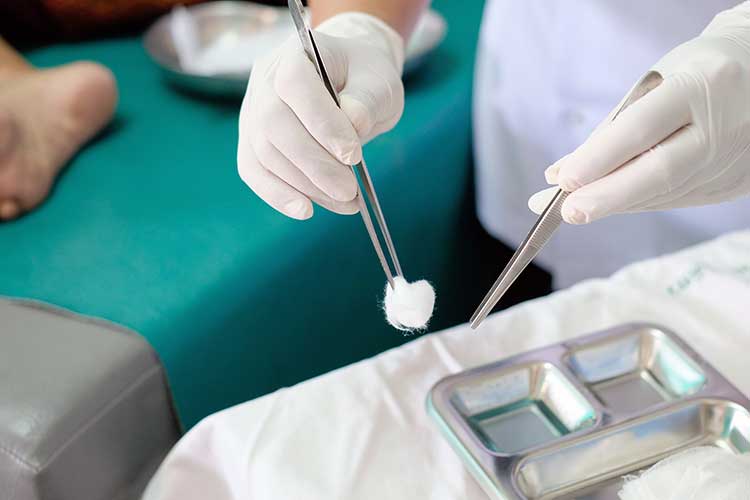
The primary goal of aseptic technique is to prevent key sites and key parts from coming into contact with pathogens. This is achieved by applying the five essential principles of aseptic technique: sequencing, environmental control, hand hygiene, maintenance of aseptic fields and personal protective equipment (PPE), alongside risk-based modifications as required(WACHS 2023; ACSQHC 2021).
Sequencing
Sequencing is a series of steps performed before, during and after a procedure. Healthcare workers should consider the following steps to adhere to aseptic technique (ACSQHC 2021).
Step 1: Performing a risk assessment
A risk assessment should be conducted prior to any procedure to identify environmental risks, determine the appropriate level of aseptic technique (standard or surgical), establish PPE requirements, and confirm that the healthcare worker has demonstrated competency (ACSQHC 2021).
The selection of aseptic technique should then be guided by the nature of the procedure and the specific key sites and key parts involved.
Choosing between standard and surgical aseptic techniques:
| Standard aseptic technique | Surgical aseptic technique | |
|---|---|---|
| Number of key parts and key sites | Few | Many |
| Size of key parts and key sites | Small | Large |
| Complexity of procedure | Simple | Complex |
| Duration of procedure | Less than 20 minutes | More than 20 minutes |
| Aseptic field required | General aspect fields and micro critical aseptic fields | Critical aseptic fields |
| Type of gloves required | Non-sterile gloves may be used with a non-touch technique | Sterile gloves |
| Procedure examples |
|
|
(WACHS 2023; CHHS 2018; ACSQHC 2021)
Step 2: Pre-Procedure Preparation
Prepare the environment, gather all necessary equipment, and obtain informed consent from the patient (ACSQHC 2021).
Step 3: Performing the Procedure
Set up equipment, perform hand hygiene, and don appropriate PPE before carrying out the procedure using aseptic technique in a safe and systematic manner (ACSQHC 2021).
Step 4: Post-Procedure
Doff PPE, perform hand hygiene, and document the procedure outcome, including any breaches and corrective actions taken (ACSQHC 2021).
Environmental control
A range of clinical environment factors can increase the risk of contamination during procedures. Activities such as bed making, cleaning, dusting and vacuuming may generate airborne particles and should be avoided during aseptic procedures.
Procedure trolleys must always be used and should be cleaned and prepared in accordance with organisational infection prevention policies (ACSQHC 2021.)
Hand hygiene
Hand hygiene remains one of the most critical measures for preventing the transmission of infection. Healthcare workers must be bare below the elbow and perform thorough hand hygiene using either soap and water or an alcohol-based hand rub (Health.vic 2023).
All staff must perform hand hygiene:
- Before touching the person
- Before performing the procedure
- After exposure to body fluids
- After touching the person, and
- After touching the person's surroundings or equipment.
(ACSQHC 2026)
Maintenance of Aseptic Fields
Maintaining asepsis is a shared responsibility. All healthcare workers must actively contribute to safety throughout the process.
This includes:
- Preparing the key site using the appropriate antiseptic solution
- Cleaning and disinfecting equipment, including wiping the trolley with disinfecting wipes prior to setting up additional equipment
- Selecting and maintaining the appropriate aseptic field for the procedure.
(WACHS 2023; ACSQHC 2021)

Types of Aseptic Fields
Three types of aseptic fields are used to maintain asepsis. Prior to commencing a procedure, the healthcare worker must determine which type is required:
- General aseptic field: Used for procedures involving a small number of key sites and key parts. Typically simple in nature and performed using non-sterile gloves (e.g. clean procedure trays and dressing trolleys).
- Micro-critical aseptic field: These fields protect individual key parts, such as the inside of syringe caps, needle tips, and sterile packaging covers.
- Critical aseptic field: Required when key parts or key sites cannot be easily protected due to procedural complexity, large key sites, multiple key parts, or extended procedural duration (e.g. CVC insertion, complex wound management, surgical fields).
(WACHS 2023; ACSQHC 2021)
Personal Protective Equipment (PPE)
PPE selection must be guided by the procedure and risk assessment. When used correctly, PPE protects both patients and the healthcare workers from exposure to microorganisms and body fluids. Examples of PPE include gloves, aprons or gowns, surgical masks, eye protection and caps (ACSQHC 2021).
Non-Touch Technique
A non-touch technique is one in which the healthcare worker avoids direct contact with key sites and key parts, thereby preventing contamination. It is an essential component of aseptic technique, even when wearing sterile gloves (ACSQHC 2019).
Hand hygiene cannot always remove all pathogens if not performed correctly; therefore, using a non-touch technique is a vital component of achieving asepsis and protecting key parts and sites.
Once identified, key sites and key parts must remain protected throughout the procedure. Key parts should only come into contact with:
- Other aseptic key parts, and/or
- The intended key site.
(ACSQHC 2019)
Performing a Procedure Using Aseptic Technique
Note: Hand hygiene must be performed at all appropriate points throughout the procedure in accordance with the 5 Moments for Hand Hygiene and organisational policies.
- Confirm the patient's identity, obtain consent, and check for any relevant allergies.
- Perform a risk assessment of the procedure, patient and environment, and implement any necessary risk control measures.
- Perform hand hygiene.
- The trolley or work surface should be wiped down using the selected appropriate solution.
- All necessary equipment for the procedure should be identified and collected.
- Hand hygiene should be performed again before setting up the sterile field by opening the procedure pack from its corners and placing sterile items into the sterile area.
- Hand hygiene is performed once more.
- The patient is prepared accordingly. Gloves should be worn as required, particularly when handling soiled dressings.
- Used gloves are discarded, hand hygiene is performed, and a fresh pair of gloves is applied.
- The procedure is carried out while ensuring all critical parts and components remain protected: sterile items are single-use and disposed of directly into the waste bag; only sterile items make contact with the target site; and sterile items must not come into contact with any non-sterile items.
- Gloves are removed and hand hygiene is performed.
- The trolley or work surface is cleaned after use, followed by hand hygiene.
(DoHHS 2015)
Conclusion
Aseptic technique is a fundamental skill and a shared responsibility among all healthcare workers. By consistently applying its core principles of sequencing, environmental control, hand hygiene, maintenance of aseptic fields and appropriate use of PPE, healthcare workers play a direct role in reducing preventable healthcare-associated infections and protecting patient safety. When performed correctly and consistently, aseptic technique remains one of the most effective strategies for minimising patient harm across all clinical settings.
To learn more, see Ausmed's training module on Aseptic Technique.
Test Your Knowledge
Question 1 of 3
Sam is preparing to perform a simple wound dressing involving a small key site and a small number of key parts. Which type of aseptic technique would generally be appropriate?
Topics
Further your knowledge
 FreeFreeFreeFree
References
- Australian Commission on Safety and Quality in Health Care 2019, Australian Guidelines for the Prevention and Control of Infection in Healthcare, Australian Government, viewed 11 June 2026, https://www.safetyandquality.gov.au/publications-and-resources/resource-library/australian-guidelines-prevention-and-control-infection-healthcare
- Australian Commission on Safety and Quality in Health Care 2024, Infection Prevention and Control Workbook, Australian Government, viewed 11 June 2026, https://www.safetyandquality.gov.au/sites/default/files/resources/attachments//d22-15794_infection_prevention_and_control_workbook_-_june_2024_pdf_version.pdf
- Australian Commission on Safety and Quality in Health Care 2023, Action 3.11 Aseptic Technique, Australian Government, viewed 11 June 2026, https://www.safetyandquality.gov.au/standards/nsqhs-standards/preventing-and-controlling-infections-standard/infection-prevention-and-control-systems/action-311
- Australian Commission on Safety and Quality in Health Care 2026, National Hand Hygiene Initiative, Australian Government, viewed 11 June 2026, https://www.safetyandquality.gov.au/clinical-topics/infection-prevention-and-control/national-hand-hygiene-initiative
- Australian Commission on Safety and Quality in Health Care 2021, Principles for Aseptic Technique: Information for Healthcare Workers, Australian Government, viewed 11 June 2026, https://www.safetyandquality.gov.au/sites/default/files/2022-01/principles_for_aseptic_technique-_information_for_healthcare_workers_-_december_2021.pdf
- Canberra Hospital and Health Services 2018, Clinical Procedure: Aseptic Technique, Australian Capital Territory Government, viewed 11 June 2026, https://view.officeapps.live.com/op/view.aspx?src=https%3A%2F%2Fwww.canberrahealthservices.act.gov.au%2F__data%2Fassets%2Fword_doc%2F0008%2F1981142%2FAseptic-Technique.docx&wdOrigin=BROWSELINK
- Clinical Excellence Commission 2026, Healthcare-Associated Infections, NSW Government, viewed 11 June 2026, https://cec.health.nsw.gov.au/infection-prevention-and-control/healthcare-associated
- Clinical Excellence Commission 2025, Infection Prevention and Control Practice Handbook 4.0, NSW Government, viewed 11 June 2026, https://www.cec.health.nsw.gov.au/__data/assets/pdf_file/0010/383239/IPAC-Practice-Handbook.pdf
- Department of Disability, Health and Ageing 2025, Standard 5: Clinical Care, Australian Government, viewed 11 June 2026, https://www.health.gov.au/resources/publications/strengthened-aged-care-quality-standards-august-2025?language=en
- Department of Health and Human Services 2015, Aseptic Non Touch Technique (ANTT) For Healthcare Workers, Tasmanian Government, viewed 11 June 2026, https://www.health.tas.gov.au/sites/default/files/2022-02/Aseptic%20Non%20Touch%20Technique%20%28ANTT%29%20-%20For%20healthcare%20workers.pdf
- Health.vic 2023, Infection Control - Standard and Transmission-Based Precautions, Victoria State Government, viewed 11 June 2026, https://www.health.vic.gov.au/infectious-diseases/infection-control-standard-and-transmission-based-precautions
- SA Health 2026, Aseptic Technique: Infection Prevention and Control Principles, Government of South Australia, viewed 11 June 2026, https://www.sahealth.sa.gov.au/wps/wcm/connect/Public%20Content/SA%20Health%20Internet/Clinical%20Resources/Clinical%20Programs%20and%20Practice%20Guidelines/Infection%20and%20injury%20management/Healthcare%20associated%20infections/Aseptic%20technique%20infection%20prevention%20and%20control%20principles
- WA Country Health Service 2023, Aseptic Technique Policy, Government of Western Australia, viewed 11 June 2026, https://www.wacountry.health.wa.gov.au/~/media/WACHS/Documents/About-us/Policies/Aseptic-Technique-Policy.pdf?thn=0