The first two articles in this series set up a definition and a lever. Value-based healthcare focuses on outcomes that matter to patients, measured against their cost (Porter and Teisberg, 2006). And the workforce is what produces those outcomes. That leaves one question unanswered, and it's the hard one. How do you know when you've delivered value?
For a long time, the answer was clinical: did the patient survive, did the infection clear, did the wound heal? Those measures matter, and they always will. But they don't capture everything a patient would call a good result. A hip replacement can be a clinical success and still leave someone unable to climb their own stairs. A cancer treatment can extend life and leave a person unable to do the things that make life worth extending. If patients define value, then the measures have to ask patients.
The gap that clinical metrics leave
Donabedian (1966) gave us "outcomes" as the third domain of quality, and he included function, patient satisfaction and quality of life, not just survival. The system was slower to catch up. For decades, hospitals measured what was easy to count from the clinical record and treated the patient's own account as an anecdote.
Value-based care closes that gap with two tools.
Patient-Reported Outcome Measures (PROMs) ask whether treatment improved what matters to the patient: pain, mobility, mental health, the ability to work or care for family. The patient reports it, usually before and after care, so you can see what changed.
Patient-Reported Experience Measures (PREMs) ask how the care was delivered: whether the patient was listened to, kept informed, treated with dignity, and moved through the system without avoidable disruption (ACSQHC, n.d.).
Together, they give you the patient's side of the ledger. A hospital can now see not only whether a procedure went to plan, but whether it left the person better able to live their life.
What a good outcome actually looks like
Teisberg, Wallace and O'Hara (2020) put language to this that's worth borrowing. They describe three patient outcomes that sit under value: Capability, the ability to do the things that are important to you; Comfort, relief from physical and emotional suffering; and Calm, the ability to get care without it taking over your life. For the patient, these are often the outcomes themselves.
There's a habit of filing patient experience under "satisfaction" and treating it as less serious than clinical data. The evidence corrects that. A systematic review by Doyle, Lennox and Bell (2013) found consistent links between positive patient experience and better clinical results: higher treatment adherence, lower readmission rates, fewer adverse events, and lower mortality across a range of conditions and settings. Patients also turn out to be reliable sensors of safety. Their reports pick up on medication communication, hand hygiene and discharge planning, the everyday behaviours that predict whether something goes wrong.
Patient experience is a signal of clinical quality.
Where Australia has taken this
This is already a system expectation, not an aspiration. The NSQHS Standards require the measurement of patient experience as part of clinical governance, so every accredited hospital is expected to capture it (ACSQHC, 2021). In New South Wales, the Patient Reported Measures program, developed by the Agency for Clinical Innovation and expanded alongside Leading Better Value Care, systematically collects PROMs and PREMs and feeds them back as value indicators (ACI, n.d.; NSW Health, n.d.).
The Australian Commission on Safety and Quality in Health Care treats PREMs and PROMs as complementary halves of the same picture: PREMs measure the experience of care, PROMs measure its results, and both support person-centred and value-based care (ACSQHC, n.d.). Measuring what patients experience is still more difficult than measuring what clinicians do. Difficult is not a reason to leave it out.
The measure is only as good as what you do with it
Here's the part that connects back to the rest of this series. Collecting PROMs and PREMs produces nothing on its own. The data creates value only when someone reads it, understands it, and changes practice because of it. That someone is the workforce.
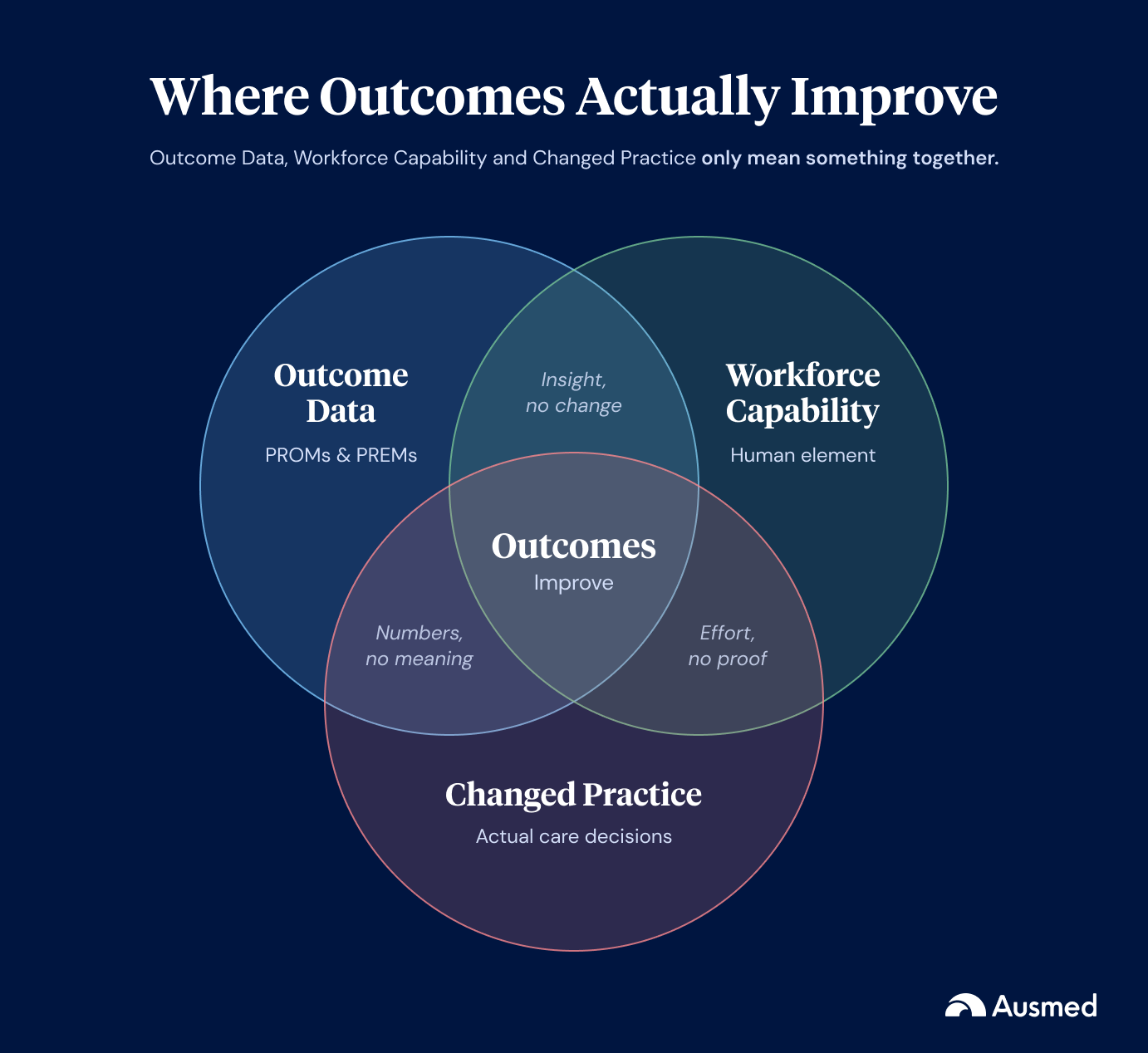
A patient completes a survey at the bedside after a staff member asks and explains why it matters. A ward reviews its readmission and experience data and spots a pattern in discharge communication. A clinician looks honestly at their own outcome data and changes how they consent and prepare patients. Every one of those steps takes capability: the data literacy to interpret outcome measures, and the clinical judgment to act on them. The IQVIA analysis of Australia's progress in value-based care identifies exactly this (IQVIA, 2024). Clinicians need data literacy to use outcome data for improvement; otherwise, the measurement stays on a dashboard, and nothing moves.
This is where measurement and workforce meet. Ausmed Analytics™ provides the workforce-capability layer of that measurement system, turning training and compliance data into a picture that managers and boards can act on. And Ausmed Learn™ builds the underlying capability, including data literacy, that enables staff to read outcome measures and respond to them. Measurement systems and capable people are two halves of the same job.
The takeaway
You can't improve what you don't measure, and under value-based care, you can't measure value at all without asking the patient. PROMs and PREMs are how a hospital hears that answer. But hearing it changes nothing unless the workforce is capable of acting on what it hears.
Which brings the series full circle. Value is the outcome that matters to the patient. The workforce produces it. Patient-reported measurement is how you know whether you've delivered it. And a capable, engaged workforce is what turns all three from ideas into results.
References
Agency for Clinical Innovation (ACI), n.d. Patient-reported measures. Sydney: NSW Health. Available at: https://aci.health.nsw.gov.au/statewide-programs/prms.
Australian Commission on Safety and Quality in Health Care (ACSQHC), 2021. National Safety and Quality Health Service Standards. 2nd ed. (version 2). Sydney: ACSQHC. Available at: https://www.safetyandquality.gov.au/publications-and-resources/resource-library/national-safety-and-quality-health-service-standards-second-edition.
Australian Commission on Safety and Quality in Health Care (ACSQHC), n.d. Patient-reported measures. Available at: https://www.safetyandquality.gov.au/data-and-measurement/patient-reported-measures.
Donabedian, A., 1966. Evaluating the quality of medical care. The Milbank Memorial Fund Quarterly, 44(3), pp.166-206.
Doyle, C., Lennox, L. and Bell, D., 2013. A systematic review of evidence on the links between patient experience and clinical safety and effectiveness. BMJ Open, 3(1), e001570.
IQVIA, 2024. Transitioning to value-based healthcare: a closer look at Australia's progress. Available at: https://www.iqvia.com/locations/australia-and-new-zealand/library/white-papers/transitioning-to-value-based-healthcare-a-closer-look-at-australias-progress.
NSW Health, n.d. Leading Better Value Care. Available at: https://www.health.nsw.gov.au/Value/lbvc/Pages/default.aspx.
NSW Health, n.d. Value based healthcare: patient reported measures. Available at: https://www.health.nsw.gov.au/Value/Pages/patient-reported-measures.aspx.
Porter, M.E. and Teisberg, E.O., 2006. Redefining health care: creating value-based competition on results. Boston, MA: Harvard Business School Press.
Teisberg, E., Wallace, S. and O'Hara, S., 2020. Defining and implementing value-based health care: a strategic framework. Academic Medicine, 95(5), pp.682-685.