Reviewing your training plans each year is a critical part of the learning and development (L&D) cycle. A training plan is not a set-and-forget item. It should not be created once and rolled over unchanged each year.
This is because a training plan represents an investment in workforce capability, staff time and organisational resources. It also shapes what people are expected to know and do in their roles. That makes it worth reviewing properly, at a minimum, every year.
For many providers, this review takes place in September and October as planning for the year ahead begins. It may inform budgets, workforce priorities and board reporting and planning for the following calendar year.
Use a continuous improvement cycle
A useful way to approach training planning reviews is as a continuous cycle:
Plan → Implement → Evaluate
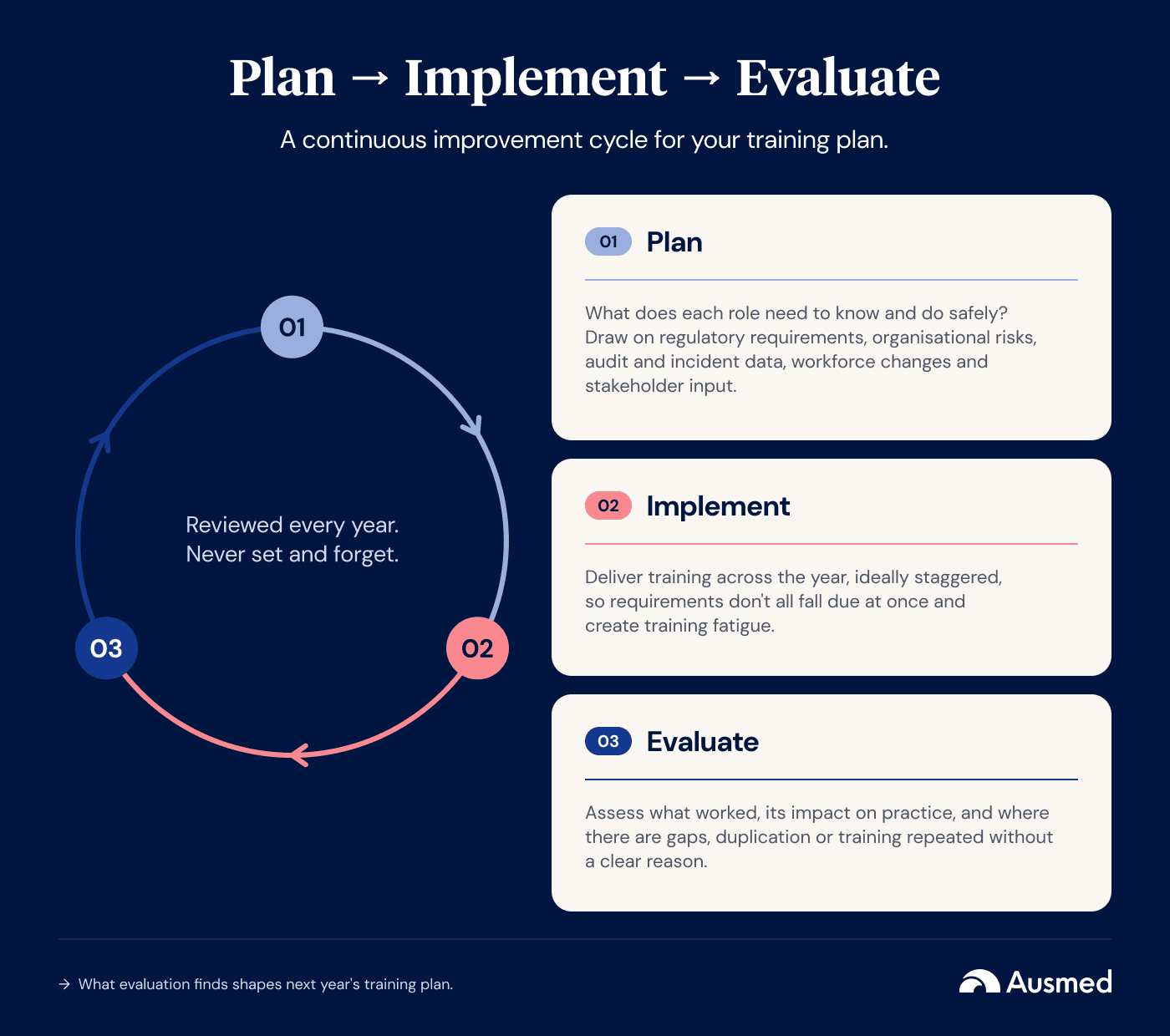
Plan the mandatory training your workforce needs. Deliver it across the year, ideally staggered. Then evaluate how successful it was, its impact and what's needed, before finalising the training plan for the next year.
An annual review helps assess whether the previous year's requirements remain relevant. It can identify gaps, duplication and training that is being repeated without a clear reason.
Start with the role
A good review is more than asking whether last year's modules should stay on the list.
Start with the job role. What does each key job role in your organisation need to know, understand and be able to do safely and effectively? This is usually more useful than starting with a broad list of core compliance topics that has built up over time.
Bring together the following information, that should shape the next training plan, including:
- regulatory and practice requirements
- organisational risks and priorities
- audit, incident and quality data
- workforce or service-delivery changes
- completion rates and learner feedback
- evidence of knowledge or capability gaps
- input from operational leaders, subject matter experts and other relevant stakeholders
Engage stakeholders early
Training requirements are often shaped by different parts of the organisation: clinical teams, operational leaders, quality and risk, human resources, learning and development, and executive teams.
A review is stronger when these perspectives are considered together. Engage the right people early. Equally important as engagement is owning accountability, which typically sits with L&D. Know who is ultimately accountable and responsible for the training plan.
Review all training plans together
Induction and annual mandatory training should form one coherent learning plan, not two separate lists.
Consider what a new starter needs before or during their first weeks, what needs reinforcement each year, and what is specific to a role, service or area of practice. This can reveal duplication, gaps or requirements that have ended up in the wrong part of the training plan unnecessarily.
Balance risk, cost and learner burden
A training plan that is too limited, is likely to be driven by a need for efficiency and cost savings. This may leave important knowledge or capability gaps. A training plan that is too extensive, with too many requirements, including all due at once, can create training fatigue, disengagement and be a huge cost burden.
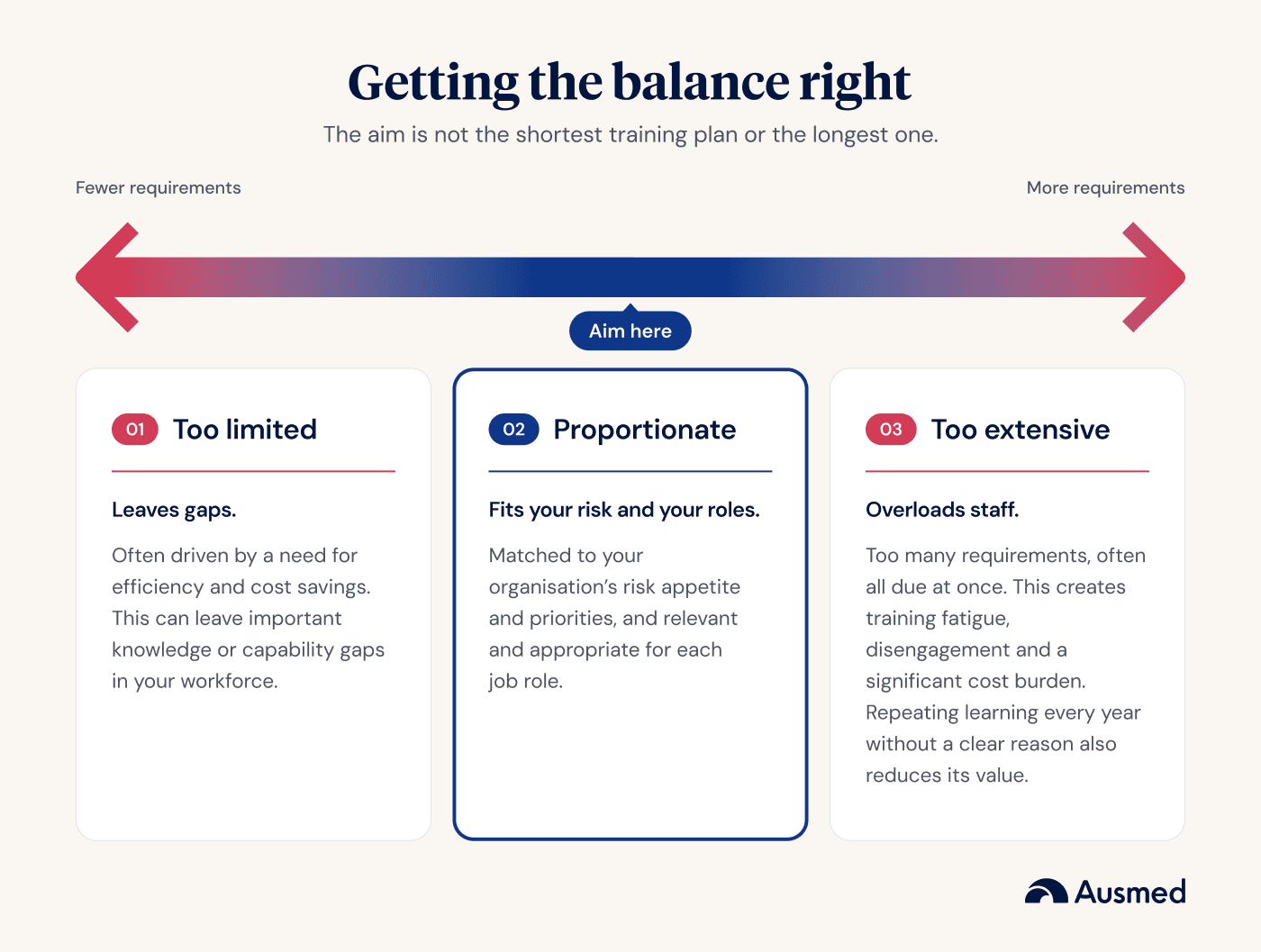
Repeating learning every year without a clear reason can reduce its value. The aim is not the shortest plan or the longest one. It is a plan that is proportionate to the risk appetite and priorities of your organisation, relevant and appropriate for each job role.
Review existing requirements
Training plans often grow because new requirements are added after an incident, audit finding, reform or standards change, while existing requirements are not reviewed.
For each item in your plan, ask:
- Is it still needed? Why or why not?
- What risk or requirement does it actually address?
- Does it overlap with another activity?
- What learning outcomes does the item genuinely address?
- Does it need to be completed annually?
- Could it sit in induction or be delivered less often, ie. biannually?
- Could the requirement be supported through another approach? For example, an assessment of knowledge or competency?
Use the right form of assurance
Mandatory training on core topics may be a compliance requirement but training is not the only way to build capability.
A learning record shows that someone completed training. Knowledge verification can show that they understood it. Competency assessment can show that they can apply it. Ongoing supervision and performance monitoring can help show whether capability is maintained over time.
These are different forms of assurance. A quiz is not a competency assessment, and a one-off competency assessment does not show ongoing performance.
The key is to distinguish between core compliance requirements, capability gaps and ongoing performance needs, then use the approach that best addresses each one.
Ausmed's Aged Care Training Benchmark Tool
Most training plans are developed internally, for your organisation only. That can make it difficult to understand how your approach compares with similar providers.
Benchmarking data is particularly valuable during the planning phase as it can help evaluate your current approach, identify opportunities to refine it, and plan with confidence before locking in next year's requirements.
Ausmed's Aged Care Training Benchmark Tool provides an anonymous reference point using aggregate Ausmed LMS data. It allows providers to compare the breadth and estimated time of annual and induction training plans with similar organisations.
It also shows how commonly particular named modules appear in mandatory training plans.
The tool is not a compliance checklist. It does not prescribe what your organisation should include, and it cannot replace your own valuable context, assessment of risks, obligations, workforce needs and organisational priorities.
Benchmarking is one key input into a sound annual review process. It can prompt useful questions where a plan appears to be below or well above typical than comparable providers, or confirm that requirements sit in a typical range.
How to use the tool
1. Choose a role to review
Start with a role where you want to examine the current requirements, such as a Care Worker.
2. Add your organisation details
This helps the tool compare your plan with similar providers.
3. Review the annual mandatory training plan
Estimate the number of activities completed each year and the total time required.
4. Review the induction training plan
Consider what new starters complete before commencing work or during their first weeks.
5. Identify your core topics
Select up to five of your non-negotiable requirements that are essential for that role.
6. Identify topics under review
Note any requirements that may need to be changed, combined, moved or delivered less frequently.
7. Identify your 2027 additions
Think of training you might need to add to this role's mandatory plan for 2027.
8. Review the comparison
Use the results to guide discussion with relevant stakeholders. It's important not to make decisions based on the comparison alone. Use benchmarking information as a key input into your overall planning process.
Turn results into improved training plans
Bring the results back to your planning process.
Consider whether the training plan reflects current risks, practice requirements and organisational priorities. Look for duplication between annual and induction learning. Check whether annual requirements remain justified and whether the required time is reasonable for the role, or the training plan risks overloading a particular job role.
When you identify an issue, decide what needs to change. That might mean removing a duplicated module, moving content to induction, reducing the frequency of a requirement, or using another method to verify capability, such as Ausmed's Knowledge Verification.
The purpose is not to copy another provider's training plan. It is to make informed decisions about your own.
Start your review
Use the Aged Care Training Benchmark Tool to review how your plans compare with similar providers and identify areas worth examining.
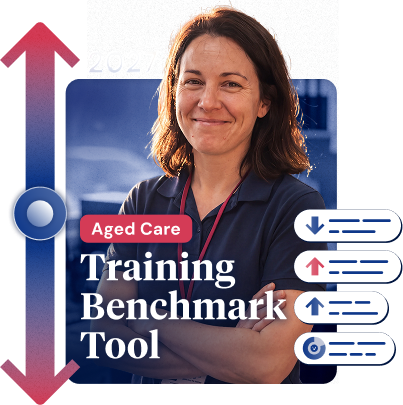
Aged Care Training Benchmark Tool
See how the breadth and estimated time of your annual and induction training plans compare with similar providers, before you lock in next year's requirements.
Request the benchmark toolIf you would like support interpreting the results or reviewing your training plan, book a time with an Ausmed team member.