Supporting Nutrition and Hydration in Home and Community Settings
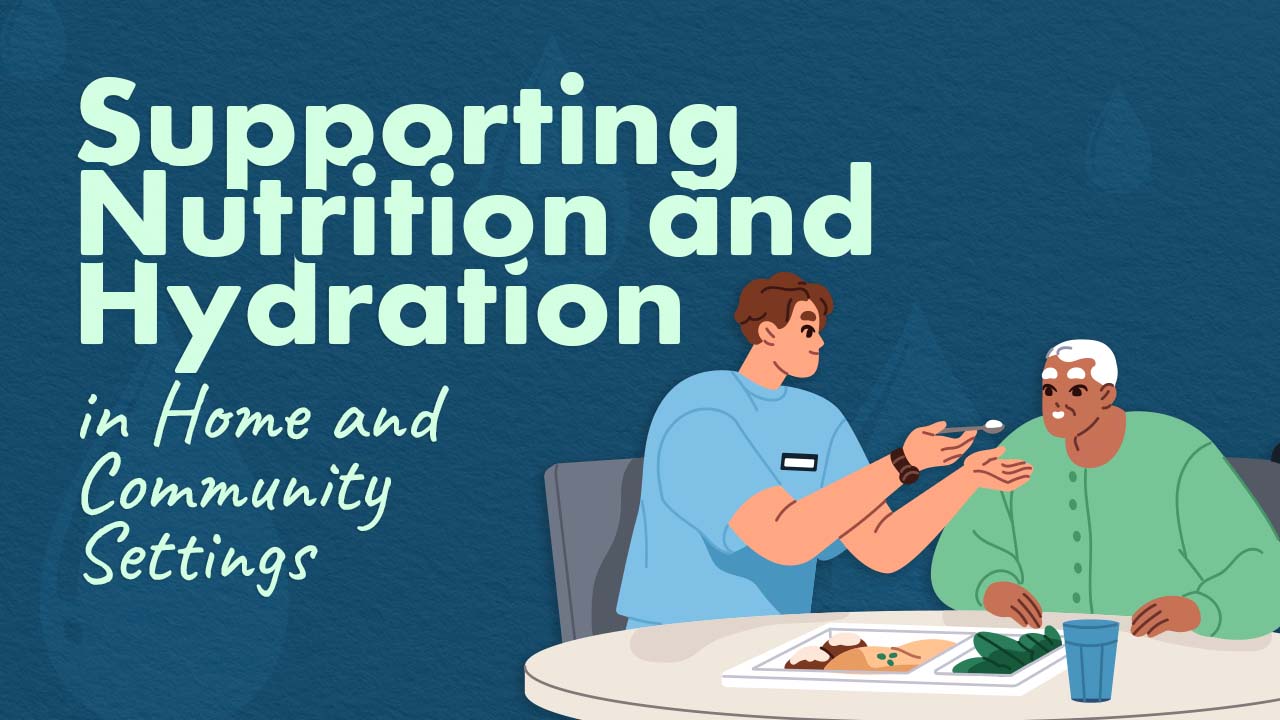
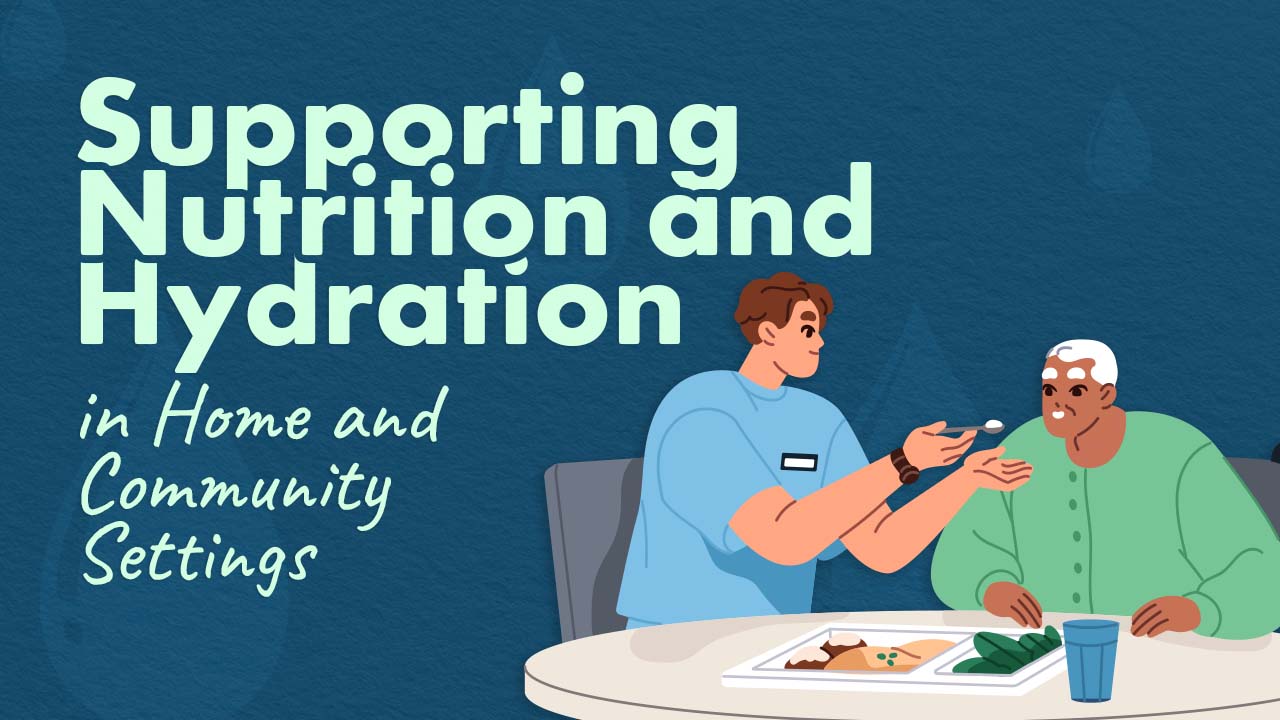
Cover image for: Supporting Nutrition and Hydration in Home and Community Settings
CPDTime.
17m
Updated 14 Jun 2026 Certificate31 Ratings

Nutrition and hydration are essential to safety, function and independence, but can be difficult for older people to maintain due to age-related changes, illness and other factors. Therefore, as an aged care worker, you play an important role in noticing changes in an individual’s nutrition and hydration when supporting them with eating and drinking.

In this Ausmed Training Module, we’ll discuss the importance of nutrition and hydration in older people, how to recognise changes in an individual’s nutrition and hydration, person-centred strategies to encourage food and fluid intake and how to appropriately document and escalate concerns.

Content

11 Units • 13 Questions
Pre-reflection
1 Question
Unit 1: Introduction
1m
Unit 2a: Why Nutrition and Hydration Matter in Home Care
1 Question
1m
Unit 2b: Risks of Poor Intake in Older People
2 Questions
1m
Unit 3a: Recognising When an Individual May Need Extra Support
1 Question
2m
Unit 3b: Signs of Low Food or Fluid Intake
2 Questions
1m
Unit 4a: Practical, Person-Centred Support Strategies to Support Nutrition and Hydration
1 Question
1m
Unit 4b: Motivating the Individual
2 Questions
1m
Unit 5a: Documentation, Communication and Escalation
1m
Unit 5b: Screening for Malnutrition
1 Question
1m
Unit 5c: When to Escalate Care
1 Question
1m
Unit 6: Conclusion
1m
Post-reflection
1 Question

What you'll learn:

1

Explain the importance of nutrition and hydration for individuals receiving aged care in home and community settings.

2

Identify signs that an individual may need additional support with eating and drinking.

3

Know how to use simple, person-centred strategies to encourage and support food and fluid intake.

4

Document and appropriately escalate nutrition and hydration concerns.

Who it's for:

Aged care workers who provide nutrition and hydration support in home and community settings.

Topics

For Teams
Assign to your staff

Assign mandatory training and keep all your records in-one-place.

Find out more

Content Integrity
Ausmed strives for the highest level of content integrity and accuracy in our educational resources.
Last updated14 Jun 2026

Published14 Jun 2026

Due for review29 Jun 2031
Disclaimer
Disclosure
Usage
Cite this resource

Recommended resources

Image for Hypoglycaemia Management in Aged Care
Hypoglycaemia Management in Aged Care
CPDTime.resource
24m
Lecture
Image for Insomnia in Older Adults: Assessment and Management
Insomnia in Older Adults: Assessment and Management
CPDTime.resource
24m
Lecture
Image for Insomnia in Older Adults: Introduction and Causes
Insomnia in Older Adults: Introduction and Causes
CPDTime.resource
16m
Lecture
Image for Insulin Therapy in Aged Care
Insulin Therapy in Aged Care
CPDTime.resource
34m
Lecture
Image for Pathology Interpretation
Pathology Interpretation
CPDTime.resource
28m
Lecture
Image for Prediabetes
Prediabetes
CPDTime.resource
31m
Lecture
Image for Prehospital-Diabetic Emergencies
Prehospital-Diabetic Emergencies
CPDTime.resource
34m
Lecture
Image for Recognising and Managing Cardiogenic Shock
Recognising and Managing Cardiogenic Shock
CPDTime.resource
21m
Lecture
Image for Sliding Scale Insulin: Best Practice Update
Sliding Scale Insulin: Best Practice Update
CPDTime.resource
15m
Lecture
Image for Unsettled Babies, Colic and Reflux
Unsettled Babies, Colic and Reflux
CPDTime.resource
28m
Lecture