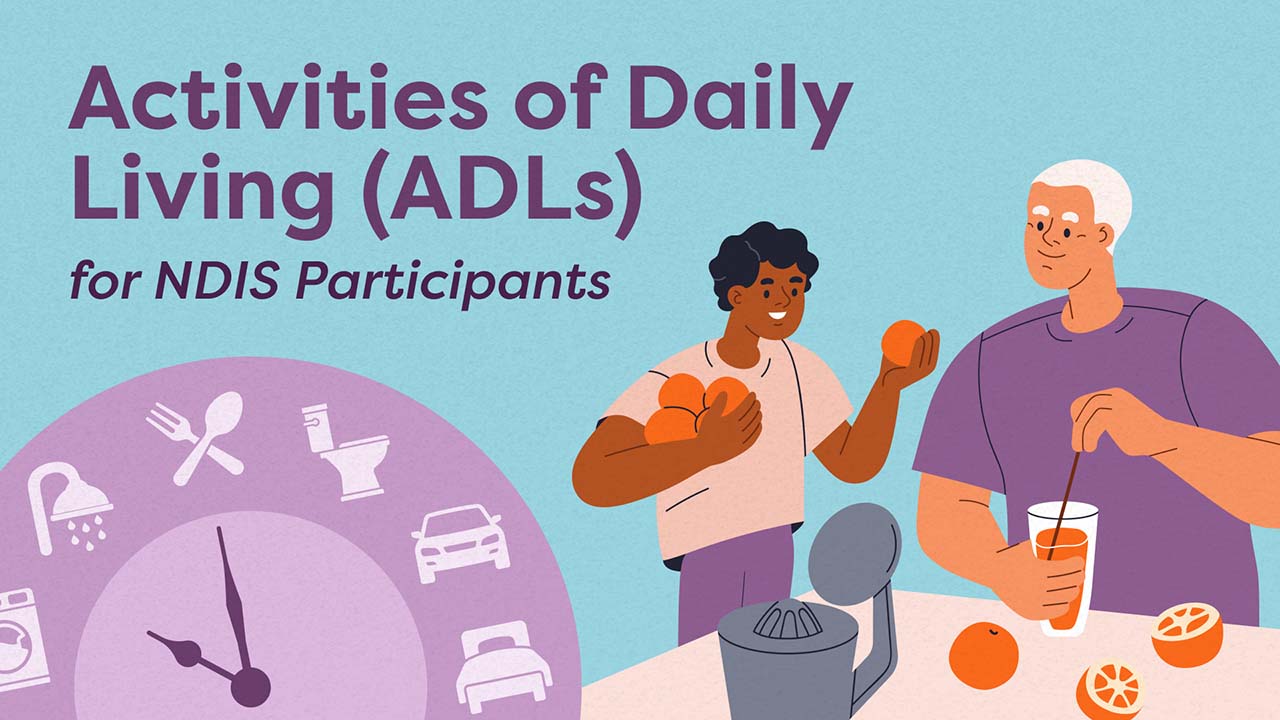
Activities of Daily Living (ADLs) for NDIS Participants
CPDTime.
37m
Updated 30 Jul 2026 Certificate21 Ratings

Activities of daily living (ADLs) are the everyday tasks that help people with disability live independently, safely and with dignity. These include personal care, mobility and transfers, meal assistance, help with household tasks, and support for accessing the community. For many NDIS participants, support with ADLs is the most consistent and personal form of assistance they receive, so how a worker delivers it directly shapes a participant's dignity, independence and trust.

This Training Module discusses what ADLs are and why they matter, how to deliver person-centred and culturally safe ADL support across different settings, and how consent and communication apply to daily tasks. It also addresses safe and ethical practice and outcome-focused documentation.

Content

8 Units • 10 Questions
Pre-reflection
1 Question
Unit 1: Introduction
1 Question
3m
Unit 2a: Importance of ADLs
2m
Unit 2b: Person-Centred ADL Support
2 Questions
4m
Unit 3: Purpose, Scope and Funding
1 Question
Unit 4a: Ethical Practice
2m
Unit 4b: Safe Practice
2 Questions
5m
Unit 5: Goals and Documentation
2 Questions
3m
Unit 6: Conclusion
2m
Post-reflection
1 Question

What you'll learn:

1

Identify what Activities of Daily Living (ADLs) are and explain why they are important for participant independence, dignity and wellbeing.

2

Demonstrate safe and respectful support with daily living tasks across home, shared accommodation and community settings.

3

Know how to apply safe work practices and duty of care within your scope of practice.

4

Uphold participant rights including privacy, dignity, cultural preferences, informed consent and trauma-informed care principles.

5

Accurately document ADL support in line with workplace and NDIS requirements.

Who it's for:

This content is intended for any worker supporting a person living with disability with activities of daily living.

Topics

For Teams
Assign to your staff

Assign mandatory training and keep all your records in-one-place.

Find out more


Meet your educator
Peer reviewed by
Content Integrity
Ausmed strives for the highest level of content integrity and accuracy in our educational resources.
Last updated30 Jul 2026

Published30 Jul 2026

Due for review30 Jul 2029
Disclaimer
Disclosure
Usage
Cite this resource

Recommended resources

Image for Hypoglycaemia Management in Aged Care
Hypoglycaemia Management in Aged Care
CPDTime.resource
24m
Lecture
Image for Insomnia in Older Adults: Assessment and Management
Insomnia in Older Adults: Assessment and Management
CPDTime.resource
24m
Lecture
Image for Insomnia in Older Adults: Introduction and Causes
Insomnia in Older Adults: Introduction and Causes
CPDTime.resource
16m
Lecture
Image for Insulin Therapy in Aged Care
Insulin Therapy in Aged Care
CPDTime.resource
34m
Lecture
Image for Pathology Interpretation
Pathology Interpretation
CPDTime.resource
28m
Lecture
Image for Prediabetes
Prediabetes
CPDTime.resource
31m
Lecture
Image for Prehospital-Diabetic Emergencies
Prehospital-Diabetic Emergencies
CPDTime.resource
34m
Lecture
Image for Recognising and Managing Cardiogenic Shock
Recognising and Managing Cardiogenic Shock
CPDTime.resource
21m
Lecture
Image for Sliding Scale Insulin: Best Practice Update
Sliding Scale Insulin: Best Practice Update
CPDTime.resource
15m
Lecture
Image for Unsettled Babies, Colic and Reflux
Unsettled Babies, Colic and Reflux
CPDTime.resource
28m
Lecture